Fast Market Understanding
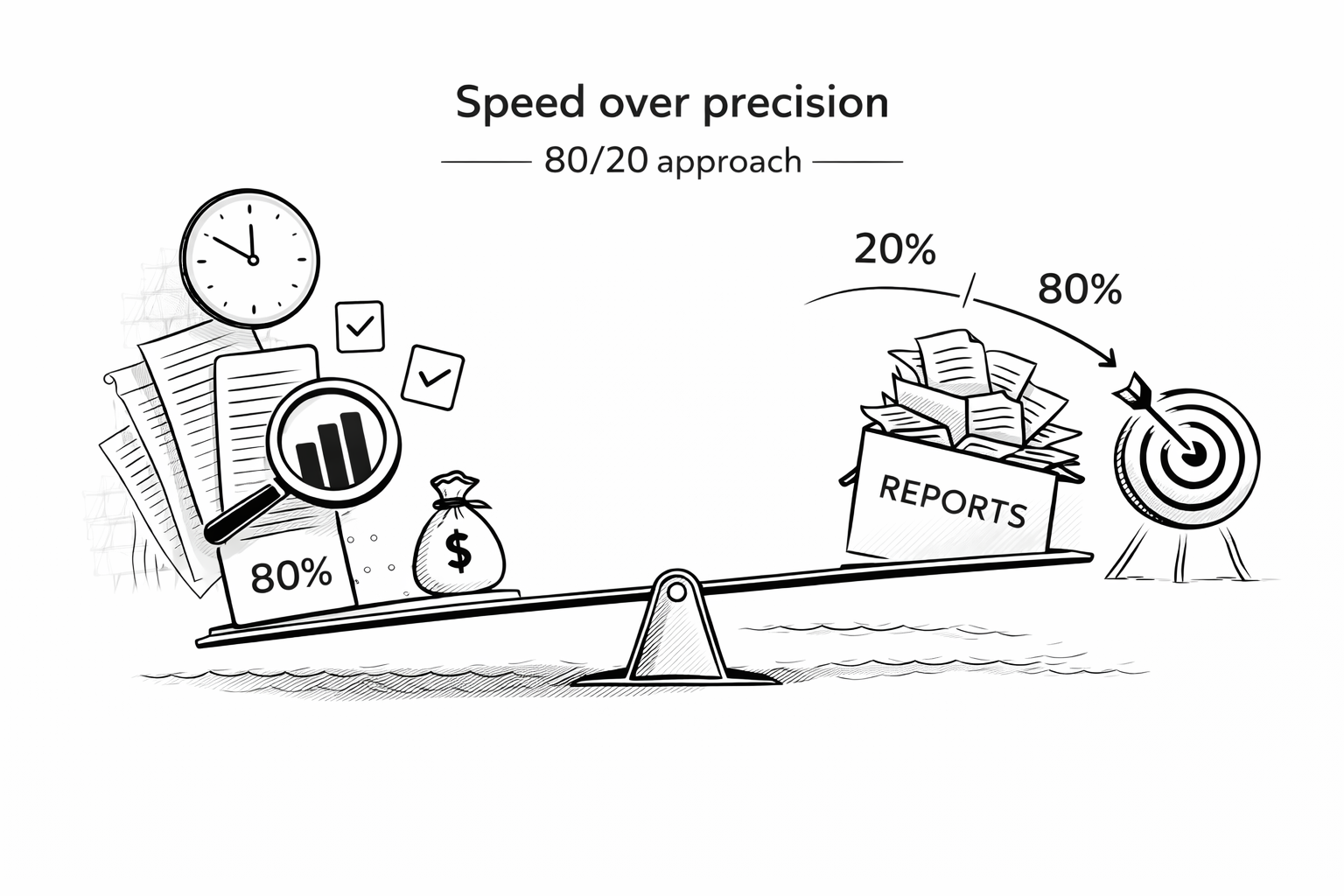
Fast Market Understanding: An 80/20 Approach (Speed Over Precision)
When you’re exploring a new market, the hardest part isn’t finding information — it’s knowing what to do with it. You can spend days reading reports, collecting stats, and opening endless browser tabs, and still end up with the same uncomfortable question: so… is this actually worth pursuing?
That’s why an 80/20 approach is so useful. Not because it’s “lazy research,” but because it’s the fastest way to reduce uncertainty early on. It helps you move from vague interest to a grounded first indication — without pretending you can get to perfect precision in week one.
Why speed matters early
Most teams don’t fail because they missed a data point. They fail because they either:
overthink the market for too long and lose momentum, or
jump in based on assumptions and only learn the truth after investing real time and money.
The goal of an 80/20 scan is to land in the middle: a fast, structured read that’s strong enough to support a go/no-go discussion — and clear enough about what still needs validation.
What an 80/20 market scan should answer
A good first-pass scan doesn’t try to prove the market. It tries to answer a small set of questions that unlock the rest. What market are we actually talking about?
Most markets sound simple until you try to define them. Boundaries matter. If you can’t clearly say what’s in and out, any numbers you find will be misleading.
Is there a real economic engine here?
You don’t need perfect market sizing, but you do need a credible range and a sense of what drives spending. Is it consumer-driven? B2B contracts? Regulation? A subscription model? Usage-based pricing?
What’s changing — and why now?
Markets become interesting when something shifts: technology, consolidation, new distribution, regulation, pricing models, customer behavior. The fastest way to understand a market is to identify the 3–5 forces that are currently reshaping it.
Who already wins in this market?
Every market has default players — the incumbents that most buyers already know and trust. Understanding who they are (and what they’re good at) helps you avoid naive positioning.
Where is the real “white space”?
This isn’t about finding an empty market. It’s about finding underserved segments, broken workflows, or unmet needs where a new entrant can realistically compete.
What would need to be true for us to win?
This is the part most teams skip. A market can be large and growing — and still be a bad fit. A strong 80/20 scan forces you to define what you’d need: distribution, partnerships, credibility, product capabilities, switching incentives.
Where a structured report helps
An 80/20 scan works best when it’s structured. Otherwise you end up with random facts instead of a coherent picture.
This is where tools like MarketInsights are useful: they generate a quick-scan market report with consistent building blocks — market scope, sizing, trends, competitive landscape, customer segments, and next steps. It’s not a substitute for real diligence. But it’s a strong way to get to a first view quickly, with assumptions and uncertainty made explicit.
One mindset shift that makes this work
Don’t treat the output as “the answer.” Treat it as your starting map.
A good 80/20 scan helps you:
get oriented quickly,
spot what matters vs what’s noise,
and identify the few unknowns that deserve deeper research.
If you do that well, you’ll move faster than teams who spend weeks trying to reach certainty — and you’ll make better decisions than teams who rely on vibes.